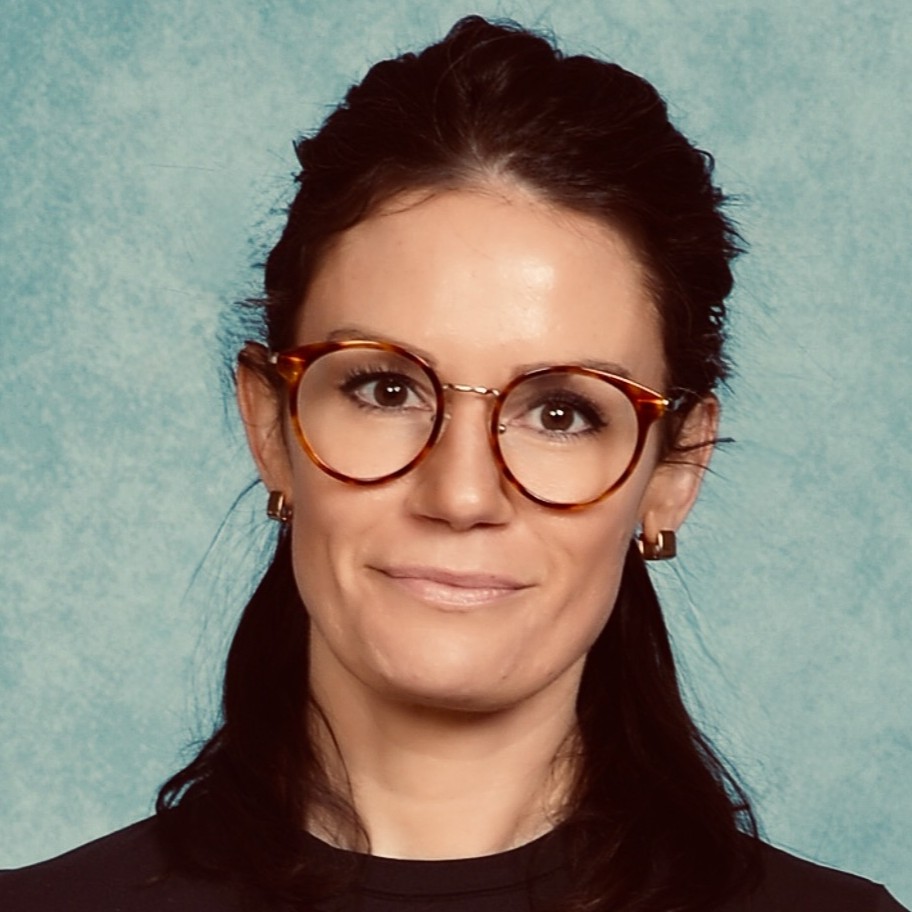
Meg Elliott Fitzgerald
Senior AI Engineer
Booz Allen
What inspired you to build a career in national security?
Early in my career, I worked in eCommerce, building the analytics and machine-learning systems behind algorithm-based digital personalization — recommendation engines, relevance scoring, marketing and behavioral analysis. It was an exciting time. Data was abundant, and the industry was pioneering new ways to build highly tailored and responsive digital experiences for users. Facebook had begun to refine its own personalized feed, and a year later Twitter transitioned away from a reverse-chronological timeline to a “relevance” based algorithm – the earliest predecessor to its current form.
But as that innovation accelerated, it became clear just how much influence those systems could have. I learned that new capabilities don’t just change the way people interact with technology, it can change how they perceive and interpret the information available to them. That realization ultimately shifted my priorities.
I wanted to apply advanced AI to missions with lasting importance, not just to optimize digital storefronts. That’s what led me into national security. Today, as an AI engineer, I still love working at the edge of what’s possible, but I approach it with a strong appreciation for thoughtful, responsible innovation.
What is the most rewarding aspect of your job?
The most fulfilling part of my work is solving the optimization challenge at the heart of applied AI: enabling people to produce better outcomes, faster. I love the solutioning process, decomposing a workflow into its fundamental components, identifying decision gateways and bottlenecks, and selecting insertion points where AI can meaningfully reduce friction without eroding accuracy or integrity. From there, designing a holistic evaluation strategy and iterating against it becomes a multidimensional engineering problem: balancing capability with responsibility, expanding performance within technical and operational constraints, and enabling autonomy while preserving user agency. That rigorous, end-to-end puzzle is what makes the job so energizing.
What is the best career advice you have received?
I didn’t begin my career with a grand strategy. I studied sociology, and it took nearly four years before I landed in a purely technical role. The path wasn't linear; I just kept leaning into what interested me, finding the skills and training I needed as I went.
Today it feels like there’s so much pressure to map out your career from day one. And while that works for some, my advice to anyone who doesn’t have it all sorted yet is this: you’re allowed to take the scenic route. Let your interests pull you forward. There’s plenty of time to build your career thoughtfully even if you don’t start with a perfect roadmap.
What is your favorite movie, book, TV show, or podcast?
I’ve always been more of a reader than a show watcher, but in 2013 I went looking for a Game of Thrones companion podcast to help me unpack Season 3. Twelve years later, I’m still listening to the same pair of podcasters—even though I no longer have time to actually watch the shows they cover.
Their recaps are so detailed that I can still follow the plot, so now it feels like listening to two funny, incisive older brothers wrestle with the most existential questions of our time through shows like Severance, Foundation, and Pluribus. I’ve even found myself discussing plot points and character arcs with real viewers who don’t know I’ve never seen an episode. Right now, I’m looking forward to their coverage of Season 2 of Fallout, which I also will not be watching.
For books, an old favorite is The Once and Future King, by T.H. White, and a newer one is Children of Time, by Adrian Tchaikovsky. And my all-time favorite movie is Clue.
What's one thing you want to change within the Intelligence Community?
One of the big ironies in the IC is that analysts often have an abundance of tools, but they rarely connect to form coherent workflows, creating gaps in functionality. At the same time, teams across the community frequently reinvent the same capabilities in parallel, because their work never escapes the small circle it was built for. The result is a paradox of “too much” and “not enough,” with enormous effort lost to duplication.
Modern software practices and AI-driven architectures give me hope. Service-oriented approaches like Anthropic’s Model Context Protocol, or agent-to-agent interoperability frameworks like Google’s A2A, enable developers to decouple functionality from front-end interfaces. Tools can be packaged as headless, reusable components and shared across workflows, allowing specialists — from data engineers to AI developers — to focus on their domain while making their work broadly consumable. This modularization shifts the focus from managing multiple point solutions to leveraging a community-wide layer of shared capabilities.
In the best version of this future, this also enables analysts to reorganize their entire digital footprint, collapsing fragmented workflows into one high-functioning, collaborative workspace that’s more powerful, more interoperable, and actually aligned with how they think and work.
Can you describe a skill you have carried throughout your career that has always proved to be valuable?
I'm pretty good at staying grounded in high-pressure situations, ignoring nerves and focusing on what needs to be done. I think I get it from my dad, an emergency room doctor whose colleagues joke that if he were any more laid-back, he’d be dead. That calm under pressure has helped me through many important moments.
It’s also made it possible to take on harder challenges in a field as fast-moving as AI and technology. Early on in my current job, every day felt like a crucible. I was a new mom, and ten years into my career, I kept wondering why it hadn’t gotten easier or more comfortable. Shouldn’t I have started developing a sense of mastery yet? What was I doing wrong? One evening, rocking my daughter to sleep, waiting for her to nod off so I could troubleshoot Elasticsearch on my phone, it hit me: what if I had simply chosen a very hard job? Realizing that discomfort often comes from picking the meaningful challenge, and not from my own inadequacy, has been a recurring lesson (or a useful delusion).
Who has inspired you?
My parents inspire me. Humility, adaptability, strength of character, gratitude, fight, humor, curiosity, wonder. When I met my husband I added generosity, duty, and selflessness to the list. Together, they’ve shown me exactly the kind of person I want to become. The challenge, of course, is living up to the example.
My advice to anyone who doesn’t have it all sorted yet is this: you’re allowed to take the scenic route. Let your interests pull you forward. There’s plenty of time to build your career thoughtfully even if you don’t start with a perfect roadmap.
Meg Elliott Fitzgerald